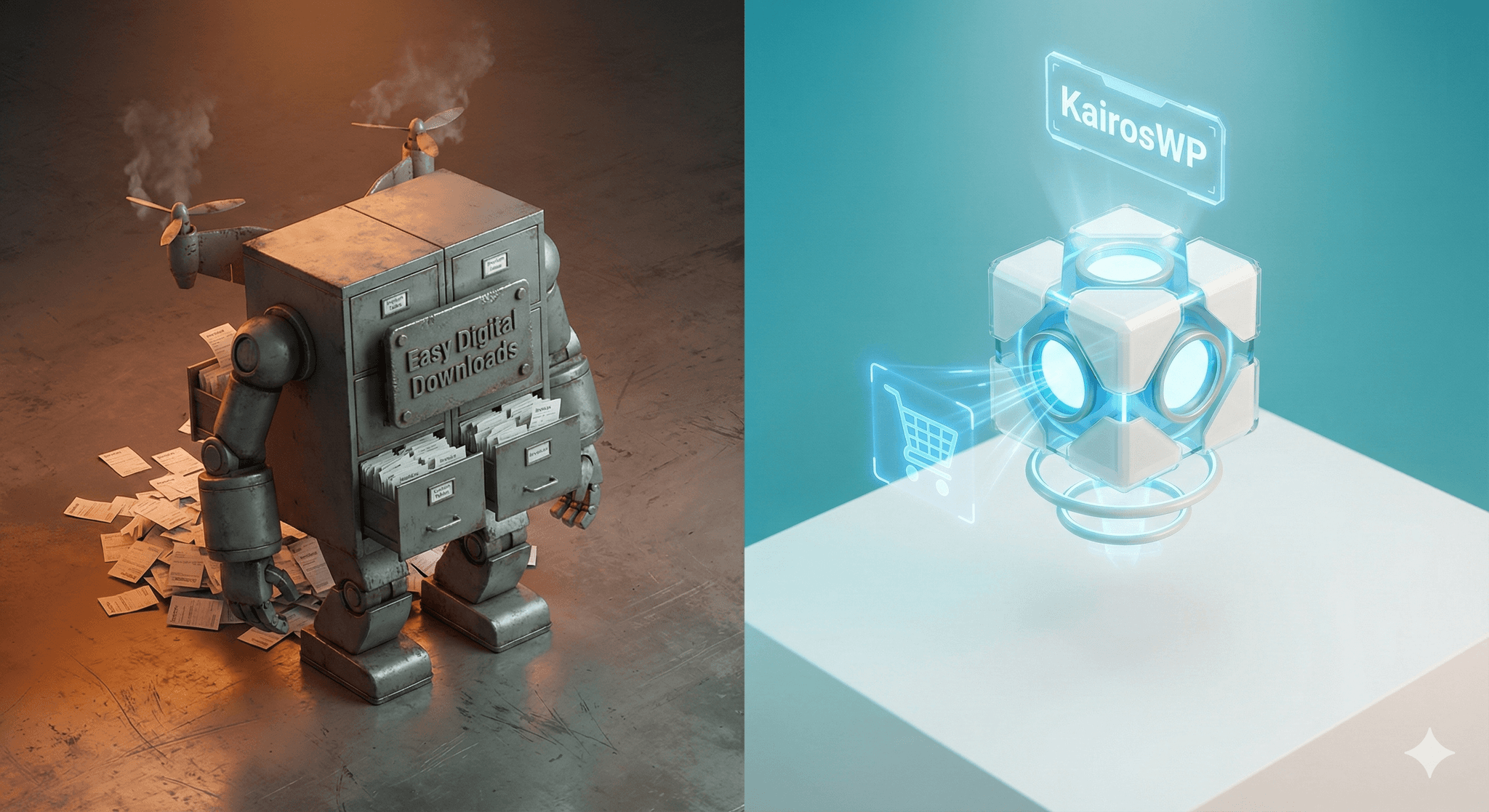
Easy Digital Downloads vs KairosWP: Why 'Custom Tables' Won't Save Your Server
If you are reading this, you probably realized that WooCommerce is a database arsonist and moved to Easy Digital Downloads (EDD) thinking you found the holy grail of lightness. And yes, EDD is "cleaner"—in the same way a single-engine Cessna is cleaner than a Boeing 747. But let’s be honest: when you start pushing serious traffic, both are going to crash if you try to land them on a $5/month shared hosting runway. KairosWP is the paradigm shift: we stop trying to optimize the engine inside WordPress and simply move the engine to the cloud, where it belongs.
The Developer's Reality Check
- 🔥 The Pain: Generating PDF invoices in PHP (DOMPDF) on your local server is a suicide mission for your RAM.
- 💊 The Fix: The Hybrid Headless model. All heavy lifting (PDFs, payments, emails) happens on Vercel, not your droplet.
- ⚡ The Reality: You can sell 10,000 subscriptions in an hour, and your WordPress database won't even know it happened.
The Problem: The "Custom Table" Mirage
Let’s talk technically. In version 3.0, EDD migrated from wp_postmeta to custom tables (wp_edd_orders, wp_edd_order_items). I applaud that. It was a necessary move to stop the JOIN bleeding.
But here is the trick: It is still YOUR database.
Even with custom tables, EDD is writing every single login, file download log, API request, and session token to your local MySQL instance.
- File Download Logs:
wp_edd_logs_file_downloadsgrows linearly with every click. - API Requests:
wp_edd_logs_api_requestsfills up faster than you can truncate it. - Invoicing: To generate a PDF, EDD has to spin up a PHP process, load a library, render HTML, convert it to PDF, and save it to your
wp-content/uploads. Do that 50 times a minute during a launch, and watch your server's CPU hit 100%.
You didn't solve the problem; you just organized the problem into neater tables.
The Comparison: Monolith vs. Headless
Let’s look at the data. This isn't marketing fluff; this is architectural fact.
| Feature | Easy Digital Downloads (Legacy) | KairosWP (Hybrid Headless) |
|---|---|---|
| Transaction Logic | Executed locally (PHP/MySQL). | Executed in the Cloud (Serverless Node.js). |
| Database Impact | High. Logs, orders, and tokens fill your DB . | Zero. Transactions live in our secure vault. |
| PDF Invoicing | CPU-intensive local generation (PHP) . | Generated on the Edge. You just get a URL. |
| Security | If your site is hacked, customer data is exposed. | Stripe Identity Shield. No sensitive data hits your WP. |
| Updates | "fingers crossed" it doesn't break your theme. | API-based. The core updates without touching your code. |
| Pricing | "Free" core + Expensive Extensions ($$$/year) . | Flat Rate or % Rev Share. Predictable. |
The Technical Solution: Decoupling the Brain
The reason KairosWP feels "illegal" to traditional WordPress developers is that we broke the golden rule: We don't trust WordPress with the money.
Our architecture uses a "Brain in the Cloud, Body in WordPress" approach.
- The Trigger: A user clicks "Buy" on your site.
- The Handoff: The request goes instantly to our API (hosted on Vercel/Cloudflare).
- The Processing: Stripe processes the card, our Node.js engine generates the invoice, emails the customer, and provisions the license.
- The Return: We send a lightweight webhook back to your site saying, "Unlock content ID #45."
Your WordPress server does nothing but listen. It doesn't sweat. It doesn't query. It just obeys.
Frequently Asked Questions
Q: Doesn't EDD have a SaaS version? A: No. They have "Managed EDD Hosting" partners, which is just them charging you more to put the same PHP code on a slightly faster server. It’s still vertical scaling, not architectural change.
Q: Can I import my EDD data to KairosWP?
A: Technically speaking, yes. Since we use Stripe, if your customers are already in Stripe, the migration is mostly mapping IDs. We don't care about your messy wp_edd_order_meta.
Q: Is KairosWP a plugin? A: It's a Connector. Think of it less like a plugin and more like a React component that lives in your dashboard but talks to a supercomputer.

Javier Baal
Software Architect & Editor at KairosWP
I like my databases like I like my coffee: black, strong, and empty of other people's garbage.